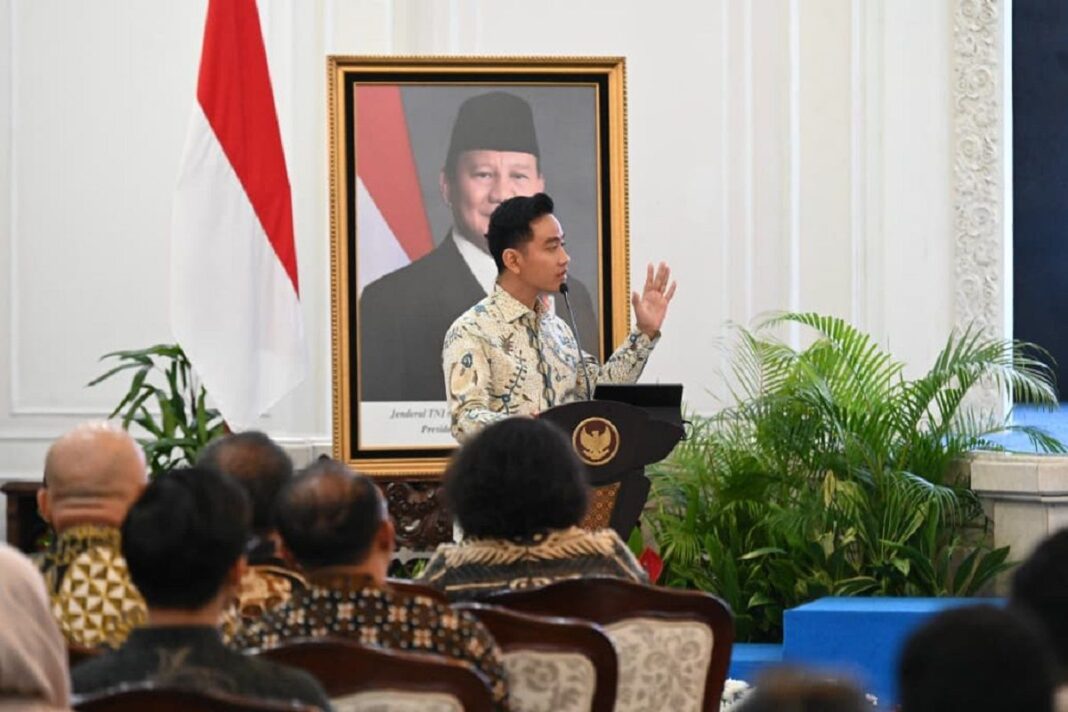

Vice President Gibran Rakabuming Raka officially sent off participants of the Digital Warriors Alumni Community Service Program on Thursday. The initiative aims to accelerate interactive digital learning within Indonesia’s underdeveloped, frontier, and outermost (3T) regions.
During the ceremony, the Vice President underscored the rapid advancement of technology and the critical need to address educational disparities across the nation. He emphasized that integrating technology into education has become a necessity amidst contemporary changes.
He further stated that successful digital transformation relies on strengthening human resource capacity to drive productivity and generate new economic opportunities. Vice President Gibran urged participants to utilize technology responsibly, develop critical thinking, and cultivate problem-solving skills to become innovators, not merely users.
The Vice President engaged in dialogue with participants from various regions, discussing their backgrounds and their upcoming assignments in 3T areas. This interaction highlighted the personal commitment of those involved in the program.
Theresia Rutisu, one of the alumni participants, expressed her dedication to serving her hometown by sharing her experiences with younger generations in 3T regions, encouraging them to pursue their aspirations. Another participant, Gulmog Simbolon, viewed the program as a vital platform for making tangible contributions to educational equity and fostering a greater motivation for learning in assigned areas.
The Digital Warrior Alumni Service Program is a collaborative effort between the Ministry of Primary and Secondary Education and the Indonesian Endowment Fund for Education (LPDP). A total of 150 LPDP alumni will be deployed for three months to 150 elementary schools in Sumedang, Kupang, North Halmahera, and Merauke. Their primary role will be to assist teachers in effectively utilizing technology and enhancing digital-based learning methods.
Through this strategic program, the government seeks to establish a more adaptive, inclusive, and sustainable digital learning ecosystem nationwide, thereby improving access to quality education for all.
Source: Original