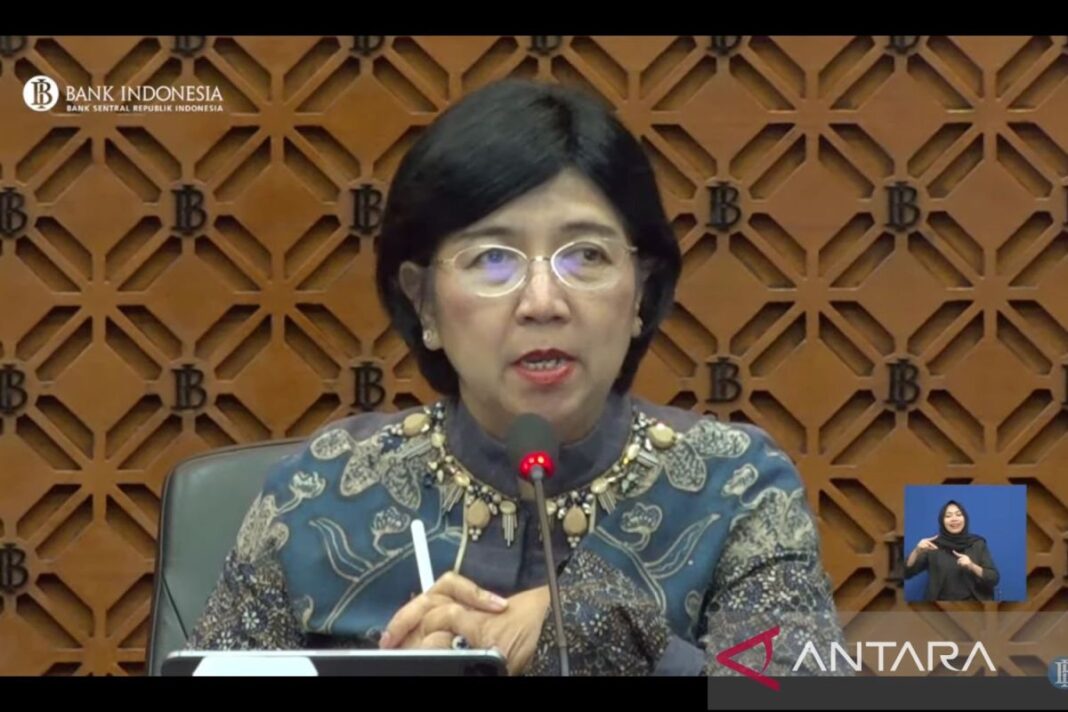

Bank Indonesia (BI) is intensifying its efforts to stabilize the rupiah, primarily by enhancing pro-market monetary operations amidst ongoing global uncertainties stemming from the Middle East conflict. The central bank has stated that maintaining stability is a key priority given the current volatile international environment.
BI Senior Deputy Governor Destry Damayanti highlighted on Tuesday that the institution consistently operates in various money markets, including the spot market, domestic non-deliverable forwards (DNDF), and offshore non-deliverable forwards (NDF, with a measured approach. She also noted the dual impact of the Middle East conflict, suggesting that rising commodity prices could benefit Indonesia as an exporting nation, potentially offsetting some of the exchange rate pressures.
On Tuesday, the rupiah exchange rate concluded trading weaker, declining by 70 points, or 0.41 percent, to Rp17,105 per US dollar, compared to its previous close of Rp16,980. Similarly, Bank Indonesia’s Jakarta Interbank Spot Dollar Rate (JISDOR) also softened, moving to Rp17,092 per US dollar from Rp17,037.
Facing these global challenges, BI has indicated it will adjust its rupiah intervention tools by calibrating responses across three scenarios related to global oil prices: moderate, medium, and high. These efforts are complemented by strategies to maintain robust foreign exchange reserves and responsive interest rate policies.
BI Governor Perry Warjiyo stated in March that the central bank continues to optimize its monetary policy through a combination of intervention instruments, sufficient foreign exchange reserves, and interest rate adjustments.
The central bank emphasizes the importance of a strong balance of payments (BOP) performance for Indonesia to mitigate the effects of the Middle East conflict and support rupiah stability. Latest data for February 2026 showed Indonesia recorded a trade surplus of US$1.27 billion, an increase from the US$0.95 billion surplus in January 2026.
Indonesia’s foreign exchange reserves remained stable at US$151.9 billion at the end of February 2026. This level is sufficient to cover 6.1 months of imports, or 5.9 months of imports and government external debt servicing, exceeding international adequacy standards.
Source: Original