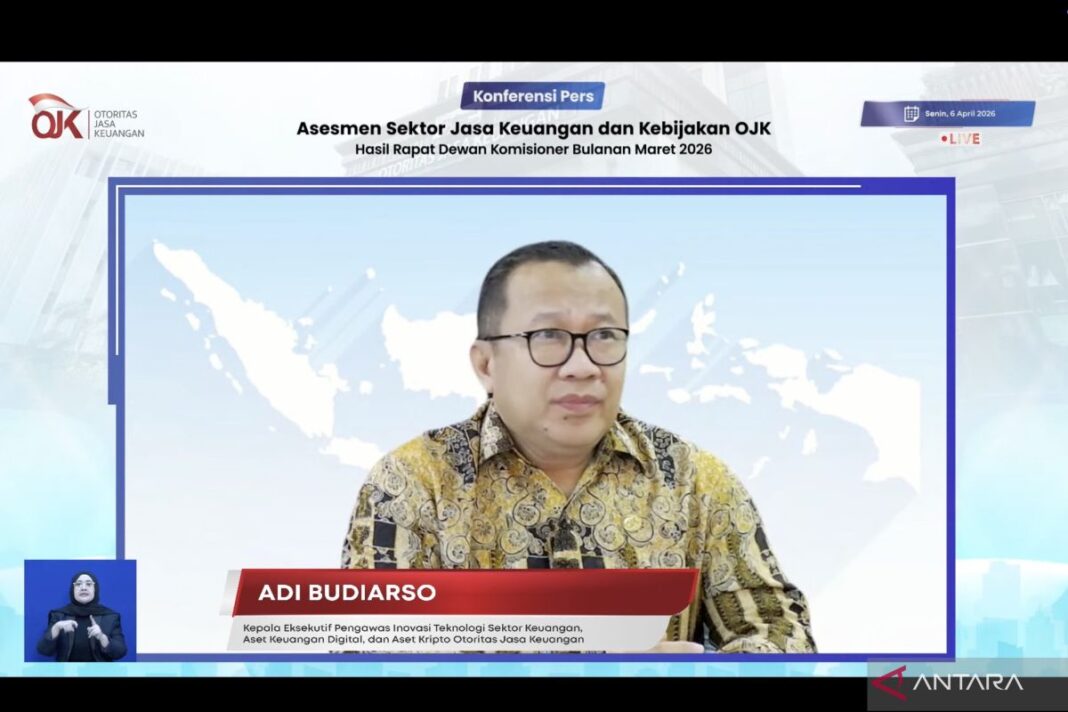

The Financial Services Authority (OJK) is intensifying efforts to bolster the domestic crypto industry following a noticeable decline in transaction values in February 2026. Crypto asset transactions reached Rp24.33 trillion (US$1.43 billion) during the month, a decrease from Rp29.28 trillion (US$1.72 billion) recorded in January.
Adi Budiarso, OJK’s chief executive for the supervision of financial sector technology innovation, digital financial assets, and crypto assets, attributed the slowdown primarily to global factors. He highlighted the impact of geopolitical turmoil, particularly the Middle East conflict, on market sentiment across decentralized financial platforms worldwide.
Rising geopolitical tensions have fostered a risk-off environment in global financial markets. Additionally, high-interest rate policies in the United States led to substantial liquidations of leveraged positions in the crypto market, further depressing transaction volumes. Budiarso noted that after a strong bull market phase in 2024, the crypto market entered a consolidation period in 2025, characterized by price corrections and reduced transaction activity.
In response, OJK is committed to strengthening the crypto ecosystem through structural measures. This includes enhancing governance standards among exchanges, clearinghouses, custodians, and crypto asset traders to safeguard consumer interests. The authority, in collaboration with the government, Bank Indonesia (BI), and the Deposit Insurance Corporation (LPS), is aligning its regulatory approach with international practices under the principle of “same activity, same risk, same regulation.”
OJK is also reinforcing law enforcement against illicit practices, working alongside the Illegal Financial Activities Eradication Task Force (Satgas PASTI) and the Indonesia Anti-Scam Center. Furthermore, the authority has issued regulations and a circular letter governing digital financial asset trading, including crypto assets. These mandates affirm that providers must maintain full ownership, dominance, and control over the systems used for trading and transaction storage.
Looking ahead, OJK is considering drafting regulations for primary market offering activities within the domestic crypto asset ecosystem, expanding beyond its current focus on secondary market trading. This initiative aims to foster the growth of local crypto asset businesses and diversify investment options for domestic investors, as global crypto assets currently dominate the market.
As of February 2026, the number of digital financial asset and crypto asset consumers in Indonesia reached 21.07 million, marking a 1.76 percent increase. Meanwhile, the value of digital financial asset derivative transactions stood at Rp5.07 trillion (US$297.87 million), down from Rp8.01 trillion (US$470.6 million) in January.
Source: Original